
If you are lifting weights and how much protein to build muscle. A practical daily target is around 1.6–2.2 grams of protein per kilogram of body weight. Approximately 0.7 1 gram per pound.
You do not need to force yourself to eat exactly 1 gram per pound to make progress. For most natural lifters. Consistently reaching a protein target. Matters more than chasing an extreme number. Buying expensive supplements or worrying about a strict post workout window.
In this article. I’ll explain how much protein can support muscle growth. How to calculate your daily protein needs. Which everyday foods can help you reach your target. I’ll also cover common mistakes beginners make. The goal is to keep it simple and practical. So you can understand what actually matters when trying to build muscle.
If you enjoy learning about athletes and their careers. Read our guide on Diana Shnaider: The Rising Tennis Star Capturing the Attention of the Sports World.
My Practical View on how much protein to build muscle
In the fitness world. Protein advice is presented as a rule rather than a range. The most common rule is that you must consume 1 gram of protein per pound of body weight every day.
I think that rule is useful as a simple upper end guideline. But it is often misunderstood. It does not mean that someone weighing 80 kilograms. Will fail to build muscle, if they eat 120 or 130 grams of protein instead of 175 or 180 grams.
Reddit discussions among natural bodybuilding and fitness communities often reach a similar conclusion. Many users refer to approximately 0.82 grams per pound. Or 1.8 grams per kilogram as a level that covers most people’s needs. Others report making progress with closer to 0.6–0.7 grams per pound. Particularly when their training, calories and recovery are consistent. These are community opinions and personal experiences. Not guarantees for every individual.
My own opinion is simple. Choose a protein target that is high enough to support muscle growth. But realistic enough to maintain every day. A target you can follow for months is more valuable than a perfect target you abandon after one week.
A Simple Protein Calculation
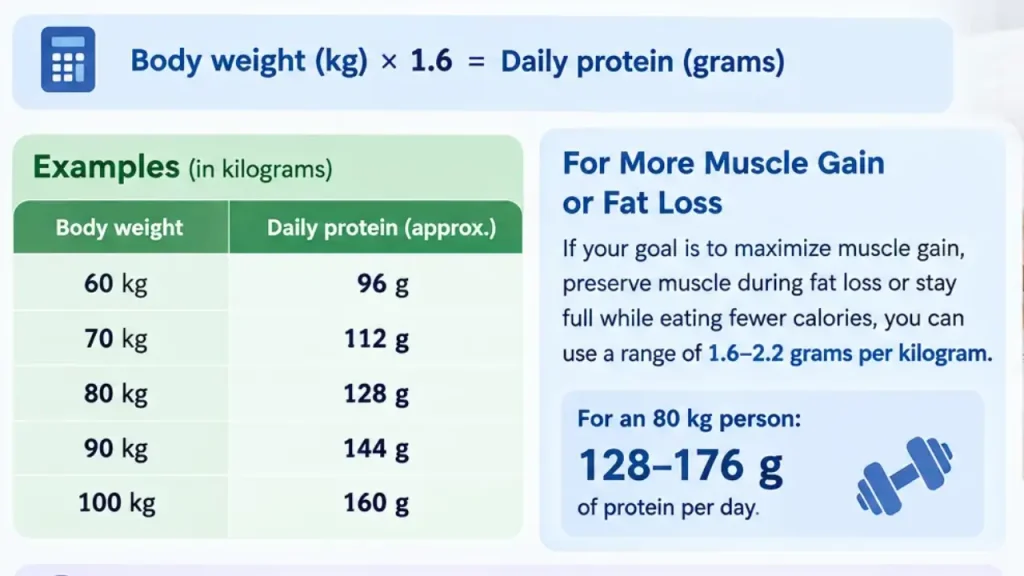
To calculate a starting protein target, multiply your body weight in kilograms by 1.6.
For example:
- 60 kilograms: approximately 96 grams per day.
- 70 kilograms: approximately 112 grams per day.
- 80 kilograms: approximately 128 grams per day.
- 90 kilograms: approximately 144 grams per day.
- 100 kilograms: approximately 160 grams per day.
If your goal is to maximize muscle gain. Preserve muscle during fat loss or stay full while eating fewer calories. You can use a range of 1.6–2.2 grams per kilogram.
For an 80 kilogram person, that would mean approximately 128–176 grams of protein per day.
You can also calculate protein using pounds. A practical range is around 0.7–1 gram per pound. The lower end may be enough for many people, while the higher end provides a simple safety margin.
Why 1 Gram per Pound Is Not Mandatory
The 1 gram per pound rule became popular because it is easy to remember. It also gives people a generous target. Which may be useful for athletes who are dieting or trying to eliminate uncertainty.
However, “more” does not automatically mean “better.” Muscle growth follows a curve. Increasing protein from a low intake to a moderate intake can be helpful. But each additional increase usually produces smaller benefits.
If you enjoy eating 1 gram per pound. It fits your calories and budget. There is nothing inherently wrong with it. You should not assume that your progress depends on hitting that number perfectly.
How much protein to build muscle for Beginners
Beginners often worry about protein before they have established a consistent training routine. In my view, the first priority is not finding the perfect number. It is building a routine you can actually follow.
A beginner should focus on:
- Training with resistance several times per week.
- Learning proper exercise technique.
- Gradually increasing repetitions, weight, or training difficulty.
- Eating enough total calories.
- Reaching a reasonable daily protein target.
- Sleeping and recovering consistently.
The early stages of training can produce noticeable progress. When nutrition is not perfect. This is why I would rather see a new lifter. Consistently reach a manageable protein target. Become overwhelmed by complicated meal plans and supplement routines.
Protein During Fat Loss
Protein becomes especially important. When you are trying to lose fat while preserving muscle.
A calorie deficit creates additional pressure on the body. Resistance training tells your body. To maintain or build muscle. While adequate protein provides the amino acids needed for recovery and adaptation.
During fat loss, many people benefit from using the upper half of the protein range:
- Around 1.8–2.2 grams per kilogram of body weight.
- Approximately 0.8–1 gram per pound.
- A target based on goal body weight or lean body mass. When current body weight includes substantial excess fat.
Using current body weight. Can create an unnecessarily high target for people with obesity. In that situation. Goal body weight or estimated lean body mass may be more practical.
Higher protein intake may also make dieting easier. Because protein rich foods are often filling. However, protein alone does not create fat loss. You still need an appropriate overall calorie intake.
Protein for Older Adults
Older adults who want to maintain or build muscle. Should pay attention to both protein and resistance training.
Muscle responds to training and protein supports the repair process. Older adults may prefer to distribute protein. Across several meals rather than eating nearly of it at dinner.
A sensible approach is to include a meaningful protein. Serving at breakfast, lunch and dinner. With an additional snack if necessary.
Anyone with kidney disease, liver disease or another relevant medical condition. Should discuss protein intake with a qualified healthcare professional. Before making a major dietary change.
Protein for Vegetarians and Vegans
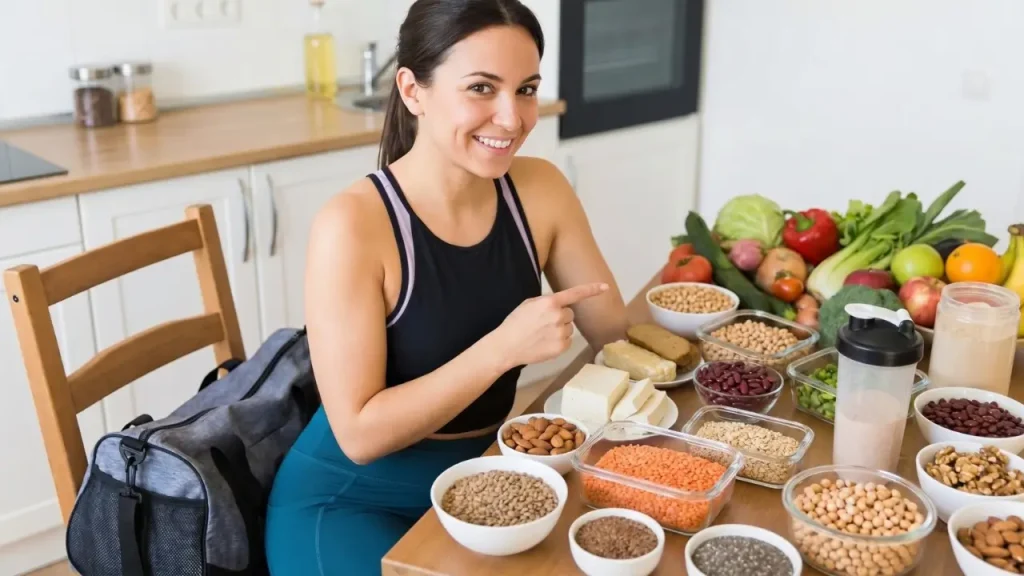
You can build muscle on a vegetarian or vegan diet, but you may need to plan your meals more carefully.
Useful plant-based protein sources include:
- Tofu and tempeh.
- Soy milk and other fortified soy products.
- Lentils, beans, and chickpeas.
- Seitan.
- Peas and edamame.
- Quinoa.
- Nuts and seeds.
- Plant-based protein powders.
Plant proteins can vary in amino-acid content and digestibility. This does not mean that plant-based lifters cannot gain muscle. It means that total intake, food variety, and meal planning deserve attention.
Some vegetarian and vegan lifters. Choose the higher end of the protein range. Because it is practical and helps compensate for the lower protein. Density of some plant foods.
Do You Need Protein Before or After Training?
The short answer is that your total daily intake matters more than perfect timing.
Many Reddit fitness discussions advise spreading protein throughout the day. Rather than worrying about whether it is consumed immediately before or after training. Users commonly report that meeting their daily target consistently. Has a greater effect on their results than drinking a shake within a strict one hour window.
You do not need to panic if you cannot eat immediately after your workout. If you consumed a protein rich meal a few hours before training. Eat another meal later. You are still following a sensible plan.
A practical routine might look like this:
- Eat a protein-containing meal two to four hours before training.
- Have another protein-rich meal or snack after training when convenient.
- Continue distributing protein across the rest of the day.
- Prioritize your total daily amount.
Some people train early in the morning and do not feel comfortable eating beforehand. Others become nauseous when they eat too close to exercise. Personal comfort matters. A plan that allows you to train consistently. Usually better than a theoretically perfect plan that makes you feel unwell.
How to Distribute Protein Throughout the Day
Although total daily protein is the most important factor. Dividing it across several meals is a practical strategy.
For someone targeting 150 grams per day, one possible structure would be:
- Breakfast: 30–35 grams.
- Lunch: 35–40 grams.
- Post-workout meal or snack: 25–35 grams.
- Dinner: 35–40 grams.
- Evening snack: 15–25 grams if needed.
Reddit users frequently recommend. Evenly spaced meals because they are convenient and easier to track. Even those who believe timing has little effect generally agree. That spreading protein can make it simpler to meet the daily target.
A Sample High Protein Day
Here is an example of how could reach approximately 140–150 grams of protein. Without relying on supplements:
Breakfast
- Three eggs.
- Greek yogurt.
- Oats or whole-grain toast.
Approximate protein: 35 grams.
Lunch
- Chicken, rice, and vegetables.
- Beans or lentils on the side.
Approximate protein: 40 grams.
Snack
- Milk-based or plant-based protein shake.
- Fruit.
Approximate protein: 25–30 grams.
Dinner
- Fish, lean meat, tofu, or tempeh.
- Potatoes, rice, or another carbohydrate source.
- Vegetables.
Approximate protein: 35–40 grams.
The exact foods do not matter as much as the overall pattern. Choose foods that match your budget, preferences, culture, and calorie needs.
Common Protein Myths
You must eat exactly 1 gram per pound
You do not. It is a convenient target, but many people can build muscle with less. A range of approximately 1.6–2.2 grams per kilogram covers the needs of many lifters.
Your workout is wasted without an immediate shake
It is not. Protein timing can matter at the margins. But daily intake, training quality, calories and recovery are more important.
You can absorb only 30 grams of protein per meal
This is an oversimplification. A meal containing more than 30 grams does not simply become useless. Your body digests and uses protein in different ways. Although distributing intake may be more convenient for supporting regular meals and recovery.
More protein always means more muscle
More protein can be useful when your current intake is too low. Once you are already consuming enough, adding more may provide little benefit. The extra calories could sometimes be better used for carbohydrates, fats. Or simply making the diet more enjoyable.
Protein powder is necessary
It is not. Protein powder is a convenient way to increase intake. But whole foods can provide all the protein you need.
You only need protein on workout days
Muscle recovery continues on rest days. Maintaining a consistent intake is usually. Easier than dramatically changing your protein target every time you take a day off.
My Recommended Starting Point
If you are unsure where to begin, use this simple plan:
- Calculate your body weight in kilograms.
- Multiply it by 1.6.
- Aim for that amount of protein daily for two to four weeks.
- Increase toward 1.8–2.2 grams per kilogram. If you are dieting, remain hungry, or prefer a higher-protein approach.
- Divide the total across three to five meals.
- Adjust your food choices based on budget, preferences, and digestion.
- Continue prioritizing progressive resistance training and adequate sleep.
For most people. This approach is more practical than trying to consume as much protein as possible.
The Bottom Line
Most people trying to build muscle. Should aim for approximately 1.6–2.2 grams of protein per kilogram of body weight per day, or roughly 0.7–1 gram per pound.
The lower end may be enough for many lifters. The higher end can be useful during fat loss or when you want additional fullness. The popular 1-gram-per-pound rule is a reasonable. Upper-end guideline, but it is not a requirement for building muscle.
Reddit fitness communities repeatedly return to the same practical lesson. Meet your daily target, choose foods you can afford and enjoy. Spread protein across your meals when convenient, and stop treating the post-workout period. As a narrow emergency window.
The best protein target is not the highest number you can find online. It is the amount you can consistently reach while training hard. Recovering well, managing your calories and maintaining your diet for the long term.
Travel can also be a great way to stay active through walking, hiking and exploring new places. If you are planning a trip, check out our guide to Best Places to Travel Solo Female in the US.
FAQ
How much protein do you need to build muscle each day?
Most people who exercise regularly. Need about 1.4–2.0 grams of protein for each kilogram of body weight per day. The right amount can be different for each person depending on their weight, exercise, age and health.
How much protein should a 150-pound person eat to build muscle?
A 150 pound person weighs about 68 kg. A simple protein target is around 95–136 grams of protein per day.
Is 100 grams of protein enough to build muscle?
It can be enough for some people. It depends on your body weight and how much you exercise. A smaller person may do well with 100 grams. While a larger person may need more.
Can you build muscle without protein powder?
Yes. You do not need protein powder to build muscle. You can get protein from foods such as eggs, chicken, fish, milk, yogurt, beans, lentils and tofu. Protein powder is simply an easy way to add more protein to your diet.
Should you eat protein on rest days?
Yes. Your muscles do not stop recovering when you leave the gym. Your body keeps repairing and building muscle on rest days. So getting enough protein each day is important.
Is it better to eat protein before or after a workout?
Both are fine. Eating protein before or after exercise can help your muscles recover and grow. What matters most is getting enough protein throughout the whole day.
Can you eat too much protein?
Yes. Your body only needs a certain amount. Eating much more than you need may make your diet less balanced. If you have kidney disease or another health condition. Ask a healthcare professional how much protein is right for you.
What is the best food for muscle growth?
There is no single best food for building muscle. Good choices include eggs, chicken, fish, milk, yogurt, beans, lentils and soy foods. The most important things are getting enough protein, eating a balanced diet and doing regular strength training.